The daily supplement market has a transparency problem.
Brands list 80, 90, even 92 ingredients on the label, then hide the actual doses behind "proprietary blends." You see the ingredient name. You don't see how much of it you're getting. And in most cases, the maths makes the answer obvious: not enough.
We spent four weeks pulling apart seven of the most popular daily supplements for men. We read every label, cross-referenced doses against published clinical research, checked third-party testing certifications, and dug through thousands of customer reviews.
What we kept finding: the supplements with the biggest marketing budgets tend to have the worst dose transparency. The brand spending $2.2 million a month on podcast ads won't tell you how much ashwagandha is in each serving. The one backed by David Beckham lists 92 ingredients, then hides three of its most important complexes behind proprietary blend totals.
One product came out well ahead of the rest. Not because it had the most ingredients or the flashiest endorsements, but because it did something almost none of the others would do: show you exactly what's in every serving, at doses that match what the research actually supports.
How We Scored These Supplements
Every product was scored across eight criteria on a 1–10 scale. We picked criteria based on what actually matters when you take a supplement every day. Not marketing claims. Not celebrity endorsements. Not Instagram followers.
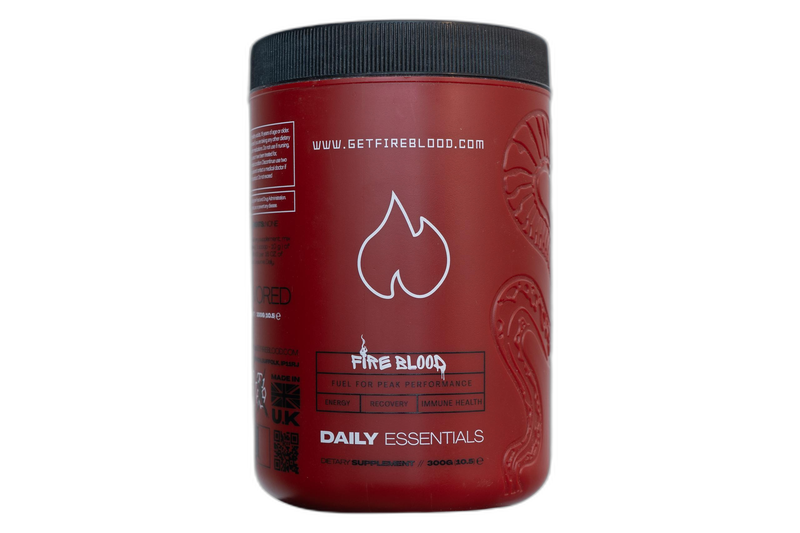
Fireblood
Fireblood does fewer things than most products on this list, and does them properly.
Thirty-nine ingredients across four categories: 15 vitamins (including choline), 12 minerals, 12 amino acids (all nine essential amino acids plus taurine, glycine, and proline), and OptiMSM. Paired vitamins K1 and K2 alongside D3.
The thing that jumps out: every single ingredient is individually dosed on the label. No proprietary blends. No "complexes" with hidden amounts. You can look at the label, find zinc bisglycinate, and see it's 11mg, which is 100% of the daily value for men.
The vitamin forms matter here too. B6 is pyridoxal-5-phosphate, not pyridoxine. B9 is L-5-MTHF, not folic acid. B12 is methylcobalamin, not cyanocobalamin. Five key minerals (magnesium, zinc, calcium, copper, manganese) use chelated bisglycinate forms for superior absorption. These are the versions your body can actually use without an extra conversion step.
The amino acid profile is where Fireblood separates from the field. AG1, Huel, Ritual, and Seed contain zero amino acids. IM8 includes aminos but buries them in a 1,580mg proprietary blend. Fireblood lists all nine EAAs plus three conditionally essential aminos.
We should address the elephant in the room. Fireblood is associated with Andrew Tate, and that's going to put some people off before they even look at the label. We get it. But this review scores products on what's inside the container, not who's promoting it. AG1 has Lewis Hamilton and Gwyneth Paltrow. IM8 has David Beckham. Onnit has Joe Rogan. Every brand in this space has a celebrity attached to it. We scored them all the same way: open the label, check the doses, compare to the research. On that basis, Fireblood's formula holds up.
- Every ingredient individually dosed, zero proprietary blends
- Bioavailable forms across the board (P5P, MTHF, bisglycinate)
- All 9 EAAs + taurine, glycine, proline
- Dual K1 + K2 paired with D3
- $2.07/day on 90-day plan
- No NSF or Informed Sport certification
- Magnesium at 100mg (24% DV), not full RDA
- Choline at 100mg (18% AI)
- No probiotics
IM8 Daily Ultimate Essentials
IM8 launched in December 2024 with David Beckham as co-founder and hit a reported $100 million annualised revenue within eleven months. The third-party testing is the best in this comparison. NSF Certified for Sport plus Eurofins verification. If you're an athlete subject to drug testing, nobody else here comes close.
The problem is in the complexes. Three of IM8's most important categories use proprietary blend totals without telling you how much of each ingredient you're getting. The superfoods complex is 4,100mg total across multiple ingredients. The amino complex is 1,580mg total with individual doses hidden. The digestive enzymes and adaptogens complex is 200mg total. A clinical dose of ashwagandha alone is 225–500mg.
Choline is listed at 55mg. The adequate intake for men is 550mg. That's 10% of what's recommended. Sodium is 5mg despite "hydration" marketing.
- NSF Certified for Sport (best in class)
- Strong vitamin/mineral section
- 10B CFU probiotics
- 3 key complexes behind proprietary blends
- Adaptogens at 200mg total (functionally useless)
- Choline at 10% of adequate intake
- Parent company net loss of $64.8M
AG1 (Athletic Greens)
AG1 is the biggest name in this space. ~$600 million in revenue in 2024, an estimated $2.2 million per month on podcast ads. The vitamin and mineral section is mostly solid. 34 individually dosed, with active B forms added in the 2025 "Next Gen" reformulation. Probiotics at 10 billion CFU across five strains. Informed Sport and Cologne List certified.
The transparency problem lives in the other half of the label. AG1's superfood complex (~21 ingredients) and phytonutrient complex (~21 ingredients) are proprietary blends. For roughly half of the 83 ingredients, the dose is unknowable.
The flagship gut health study enrolled 30 participants over four weeks and produced a p-value of 0.058. It failed to reach statistical significance. Bryan Johnson publicly called AG1 "not worth the money."
No amino acids. Zero. Not a single EAA in the formula.
- Strong vitamin/mineral section with active forms
- Informed Sport + Cologne List certified
- Probiotics at 10B CFU
- ~42 ingredients hidden in proprietary blends
- Clinical trial failed statistical significance
- Zero amino acids
- $79/mo (27% more than Fireblood)
- Next Gen taste complaints
Seed DS-01 Daily Synbiotic
Seed is not a multivitamin. It's a probiotic, and it's one of the best probiotics on the market. The DS-01 contains 24 strains totalling 53.6 billion AFU with ViaCap double-encapsulation clinically shown to deliver ~50% of viable organisms to the small intestine. The Scientific Advisory Board includes members from Harvard Medical School and NIH.
The reason Seed scores 4.7 is scope. No vitamins. No minerals. No amino acids. It does one thing. If you're looking for a single product to cover your daily nutritional bases, this isn't it.
Customer experience is where Seed takes its hardest hit. Trustpilot sits at 1.8/5 vs 4.6/5 on their own site. Complaints include charges after cancellation and a refund policy covering the first order only.
- 53.6B AFU across 24 strains
- ViaCap double-encapsulation technology
- Credible science advisory board
- Probiotics only. No vitamins, minerals, or aminos
- 1.8/5 Trustpilot
- First-order-only refund policy
- Full product not clinically trialled as combined formulation
Ritual Essential for Men 18+
Ritual does something almost no other brand does: it tells you exactly where every ingredient comes from, with named suppliers and geographic origins. Their "Made Traceable" programme is real supply chain transparency, and credit where it's due.
The problem is what's inside. Ten nutrients total. Magnesium at 30mg (7% DV). Zinc at 2.4mg (22% DV). A handful of almonds contains more magnesium. No vitamin C, no calcium, no selenium, no full B-complex, no amino acids, no probiotics.
Trustpilot sits at 1.6/5. BBB complaints describe unauthorised charges and customers cancelling credit cards to stop billing.
At $33/month for ~4 ingredients at doses that actually do something, Ritual costs $8.25 per effective ingredient per month. That's poor value even though the sticker price looks cheap.
- Full supply chain traceability
- Good vitamin forms (methylfolate, methylcobalamin)
- Low sticker price
- Only 10 ingredients
- Magnesium 7% DV, Zinc 22% DV
- No USP certification for men's product
- 1.6/5 Trustpilot (worst in this comparison)
Huel Daily Greens
Huel's serving size is 8.5 grams. Divided across 91 ingredients, the average is 93 milligrams per ingredient. Many clinically studied compounds require 200mg, 500mg, or more.
The Adaptogen & Super Mushroom Complex is 171mg total, split across 12–14 ingredients including ashwagandha, rhodiola, three types of ginseng, lion's mane, and cordyceps. A clinical dose of ashwagandha alone is 225–500mg. The entire complex is smaller than one effective dose of one ingredient.
The UK's Advertising Standards Authority banned Huel's ads twice in two months (August and September 2024) for misleading health claims. Taste is the most common complaint: "rancid," "pond water with mushrooms," "gritty."
- Lowest price point ($1.50/serving)
- Broad category coverage
- Vegan, non-GMO
- 91 ingredients in 8.5g = universal under-dosing
- Adaptogens 171mg for 14 ingredients
- Probiotics 80x weaker than AG1
- UK regulator banned ads twice
- Taste widely criticised
Onnit Total Human
Onnit Total Human bundles ten standalone supplements into day and night packs. Joe Rogan owns 50% of Onnit. He got the equity for brand ambassador services, not a cash investment. Unilever bought the company in 2021.
The dosing is hidden behind ten proprietary blends. The Tranquility Blend is 225mg across four ingredients. Clinical dose for valerian alone is 300–600mg. DHA is 30mg per serving; recommended is 1,000mg. Innerbody rated Total Human 3.9 out of 10 and called it "more like a sample pack than a multivitamin."
Sixteen capsules per day. $4.60/day. $138/month divided by ~8 verifiably-dosed ingredients = $17.25 per effective ingredient. The worst value on this list, and it's not close.
- Broad category coverage
- Day/night timing protocol
- 10 proprietary blends
- Half-doses of own standalone products
- 16 pills per day
- $4.60/day, most expensive by far
- No third-party testing certification
- 2024 Alpha Brain lawsuit